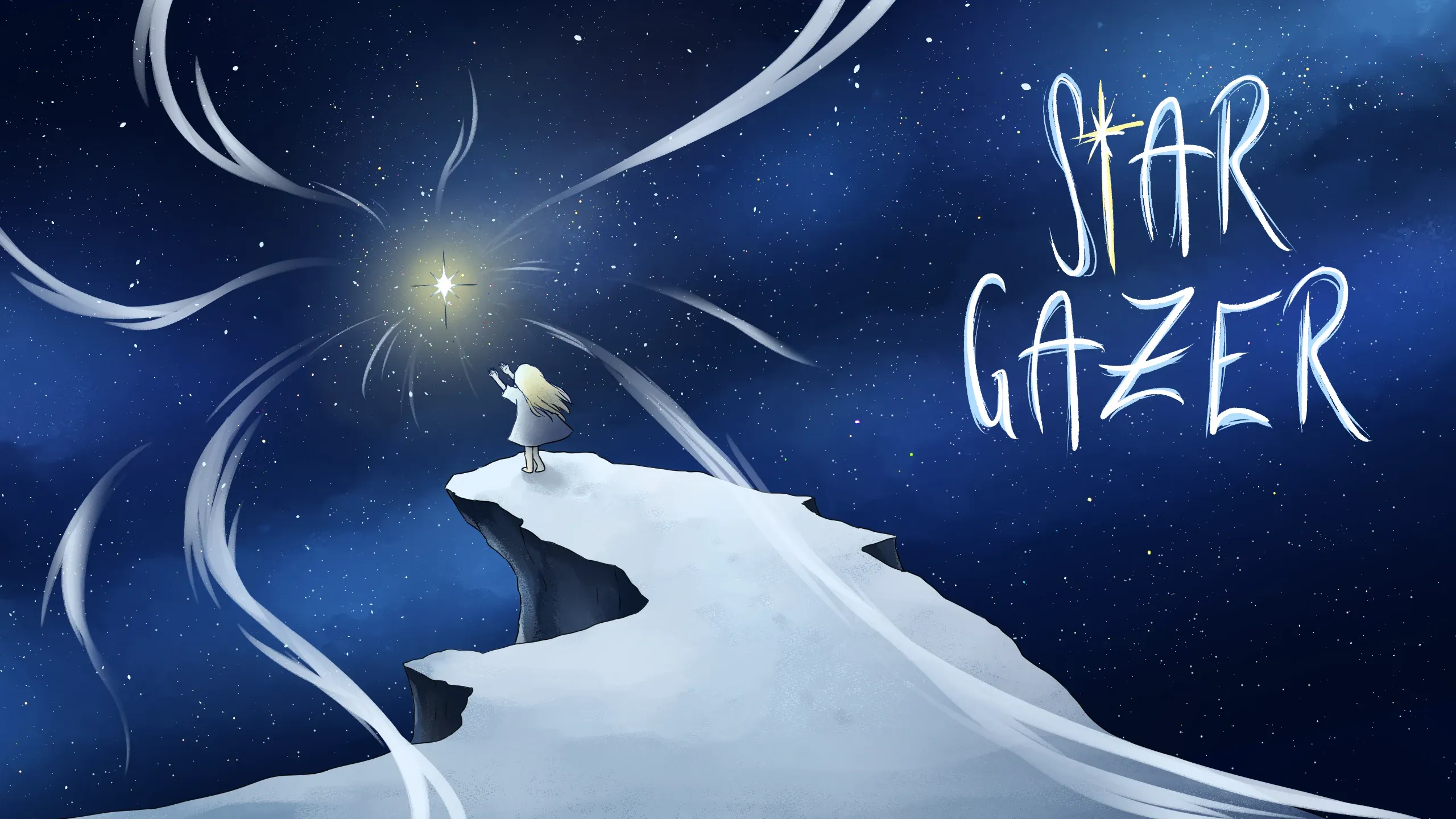
Stargazer
A tragic point-and-click retelling of the Brothers Grimm fairy tale The Star Money.
Trailer
Design breakdown
- Core mechanic
- Puzzles are solved by giving the orphan girl's belongings away. Each gift unlocks a constellation and summons a star spirit to help her.
- Emotional arc
- Every act of kindness deepens her tragic fate and moves the story toward its ending.
Stargazer is a reimagining of “The Star Money,” a classic fairy tale by the Brothers Grimm, retold as a tragic point-and-click adventure. We developed it over four months as a university project. Players take the role of a nameless orphan girl wandering through a cold winter night in the medieval European wilderness. Where typical adventure games have you take or destroy objects, Stargazer asks you to give: puzzles are solved by handing away the girl’s few belongings, making her a gentle source of warmth and comfort in an otherwise harsh and somber world.
By helping others, the protagonist unlocks constellations and summons powerful star spirits that assist her on her journey. Each act of kindness, though, deepens her tragic fate, and the story ends with her death. As game designer, I shaped the core gameplay and worked to make the adventure genuinely emotional and memorable.
This project made me dive deep into puzzle design. The concept that shaped my work most is treating the player’s working memory as a limited resource. Every rule, object, possibility, and distraction consumes mental capacity, and novices burn through it faster than experts because they cannot yet dismiss the dead ends. Stargazer therefore introduces each concept on its own and gives players time to internalize it before puzzles start combining them. Closely related is removing noise, meaning anything that consumes attention without contributing to the solution. Noise makes a puzzle artificially difficult by testing whether the player can see through clutter instead of letting them reason about the problem. My editing technique for this: describe the solution in one sentence, then question every element that sentence does not mention.
That solution sentence also became the seed of each puzzle. The best levels revolve around a single conceptual realization, one clear aha moment, so I wrote that realization down first and built the smallest scene able to express it. Difficulty had to come from reasoning, not execution; designers become expert users of their own controls and routinely underestimate them, and once a player understands the answer but cannot perform it, the experience stops being about puzzle-solving. I also learned to cut. Exploring every permutation of a mechanic tempts the designer, and I dropped the variations that added nothing for the player. In the end, the strongest puzzles were never conceived fully in advance. They emerged from a small set of diverse mechanics interacting in surprising ways: you create the system, and the system delivers the puzzles.